By Kenneth Christiane L. Basilio, A reporter
Japanese soldiers will take part in annual war games in the Philippines for the first time next month as Manila and Tokyo seek to strengthen cooperation amid shared security concerns with China.
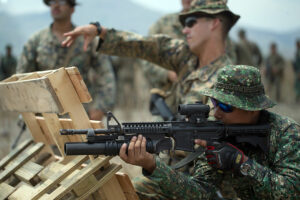
Japanese troops will participate in Philippine military exercises in Balikatan in April alongside the US military, in what is expected to be the largest and most intense exercise to date, Philippine Army Chief General Romeo S. Brawner, Jr. said. on Tuesday.
“For the first time, after a very long time, combat soldiers from Japan, from the Japanese Defense Forces, will come here to the Philippines to join us in the Balikatan operation,” he told reporters on the sidelines of a briefing organized by the Stratbase Institute think tank.
“Besides having more participants – we can see the participation of Japan – this will expand the scope of our defense activities,” he said in mixed English and Filipino. “Our exercises will be more extensive, and we will be better prepared for whatever happens.”
The Armed Forces of the Philippines will launch Balikatan – Filipino “shoulder-to-shoulder” – on April 20, said Mr. Browner.
The annual drills have turned into a rematch in Southeast Asia as the Philippines and its allies deepen security cooperation to counter China’s growing assertiveness in the region.
The Philippine and US militaries usually focus on the exercises, but Japan’s participation this year highlights Manila’s efforts to expand its network of security partners beyond Washington.
Mr. Brawner declined to provide details on the extent of Japan’s involvement but said the exercise would be more intense and would include efforts to strengthen capabilities against emerging threats, including cyberwarfare. Japan is expected to participate in command and control exercises and live fire exercises.
“I will not be able to reveal the exact numbers of what kind of units are coming or the equipment they will bring here, but suffice it to say that they will send a large team,” he said.
Japan’s participation is particularly noteworthy given its Constitution of Non-Transformation, which was imposed by the US after World War II condemning the use of military force. Japan invaded several Asian countries during the war, including the Philippines.
“In 1945, we found ourselves on different sides of the war,” said Mr. Browner. “This time, we find ourselves on the side of efforts to promote a rules-based international order.”
Japan has emerged as a “like-minded partner” of the Philippines in promoting regional stability, Mr. Brawner said, as China steps up what Manila describes as coercive actions in the South China Sea while Tokyo deals with its maritime disputes with Beijing.
“A partnership that not only responds to current challenges, but anticipates future needs based on mutual respect, guided by shared values and committed to lasting peace and stability,” he said.
China claims sovereignty over most of the South China Sea based on the so-called nine-dash line map that dates back to the 1940s.
The claim overlaps with the economic zone of the Philippines, where Beijing has sent coast guard ships and marines despite a 2016 ruling by a United Nations-backed court that rejected its claims. Beijing continued to reject the decision.
Like the Philippines, Japan is also embroiled in a dispute with China over the Senkaku Islands, which are close to major shipping lanes and believed to be rich in marine resources.
“Some countries only promote their interests and they do this by coercion, forcing what they want to happen in the region,” said Mr. Brawner. “That cannot be allowed.”
“That is why the alliances we are building are important, and one of our most important partners is Japan,” he added.
Separately, the Philippine Coast Guard (PCG) said the Chinese coast guard plans to conduct a “clearance operation” near the disputed Scarborough Shoal, a traditional fishing ground for Filipino fishermen.
In a statement, the PCG said it sent ships to protect more than 20 Philippine fishing boats from harassment after monitoring a Chinese coast guard vessel that broadcast its “intention to conduct a cleanup operation” in the southeast shoal.
China’s embassy in Manila did not immediately respond to a request for comment sent via Viber.
Two PCG vessels, along with five patrol boats from the Bureau of Fisheries and Aquatic Resources, were sent to escort the Filipino fishermen in the area.
The deployment followed last week’s incidents in which Chinese coast guard vessels allegedly used sirens and deployed inflatable boats to chase Filipino fishermen away from the disputed feature.
“The joint deployment ensured the safety and security of Filipino fishermen,” the PCG said, adding that the authorities also provided fuel, food packs, and ice packs to expand their fishing operations in the area.